
Justice at the Water’s Edge: Part of the Francis Scott Key Bridge Settlement
May 21, 2026
May 25, 2026 · By Charles F. Herd
Francis Scott Key wrote his most famous lines of the poem that would become “The Star-Spangled Banner” while watching cannon fire light up Baltimore Harbor — a lawyer turned poet, scribbling verse by the glow of battle from the deck of the HMS Tonnat, a British sloop. It seems fitting that the bridge bearing his name has now given rise to one of the most significant developments in American maritime law in a generation.
The First Settlement: $2.25 Billion and What It Covers
Just to recap what we have previously covered: on May 12, 2026, Maryland Attorney General Anthony Brown announced the finalization of a $2.25 billion settlement with Grace Ocean Private Limited and Synergy Marine Pte. Ltd. — the Singapore-based owner and operator of the M/V Dali, the container ship that struck the Francis Scott Key Bridge in the early morning hours of March 26, 2024, killing six construction workers and triggering the bridge’s catastrophic collapse.The ship’s owners then originally moved to limit their total liability to just $43.6 million under the venerable Limitation of Liability Act of 1851 (a 175-year-old federal statute that allows vessel owners, in certain circumstances, to cap their exposure at the post-casualty value of the ship and her freight). However, the final settlement, at $2.25 billion, is roughly 51 times that amount, making it the largest maritime property damage settlement in U.S. history.
This settlement resolves the state’s claims on behalf of the Maryland Transportation Authority, the Maryland Port Administration, and the Maryland Department of the Environment.
What the settlement does not cover is equally important. It does not resolve Maryland’s separate claims against Hyundai Heavy Industries (HHI), the South Korean shipbuilder the National Transportation Safety Board identified as bearing fault for the M/V Dali’s design. It also does it settle the claims of the families of the six workers who lost their lives, or those injured, whether economically or personally, who are pursuing their own actions through separate lawsuits. Those cases remain ongoing.
The Criminal Indictment: Cutting Corners Goes to Court
The settlement announcement was not the only bombshell dropped on May 12. The same morning, the U.S. Department of Justice unsealed an 18-count federal criminal indictment against Synergy Marine Pte. Ltd. (Singapore), Synergy Maritime Pte. Ltd. (India), and the vessel’s technical superintendent, Radhakrishnan Karthik Nair, a 47-year-old Indian national. The charges include conspiracy to defraud the United States; willfully failing to report a known hazardous condition to the U.S. Coast Guard; obstruction of an agency proceeding; false statements; misconduct or neglect of ship officers resulting in death; and violations of the Clean Water Act. The DOJ’s central technical allegation is striking in its specificity: prosecutors contend that Synergy improperly modified the M/V Dali’s fuel supply system, substituting a flushing pump (a device designed only to clear debris from fuel lines) as a continuous fuel source for two of the vessel’s four generators. Unlike the proper supply pumps, the flushing pump had no automatic restart capability after a blackout. When the M/V Dali lost power a second time as she approached the bridge, the flushing pump could not restart, the generators could not re-fire, and the crew lost propulsion and steering at the worst possible moment.
Acting Attorney General Todd Blanche called the collapse “a preventable tragedy of enormous consequence.” FBI Special Agent in Charge Jimmy Paul also has directly stated the bridge fell because those responsible “deliberately cut corners at the expense of safety.”
Synergy has denied the charges, arguing that the DOJ’s framing is inconsistent with the NTSB’s own findings, which traced the probable cause to a loose signal wire that was a latent manufacturing defect, not an operational failure. Hence, the battle of competing technical narratives is now being fought on two fronts simultaneously: civil and criminal.
What Happened to the Ship? The NTSB Final Report
The National Transportation Safety Board released its final report on the accident in November 2025. The board determined the probable cause to be a loose signal wire in the ship’s electrical control center (a wire had come loose because an improperly attached plastic label, which is believed to have prevented it from seating correctly in its socket). The NTSB also found the defect could have been detected with routine thermal imaging equipment, and recommended corrective action from WAGO Corporation, which supplied the terminal blocks, and Hyundai Heavy Industries, which installed them.Crucially, the NTSB did not identify Synergy Marine or the crew among the probable or contributing causes of the allision (an allision, in maritime law, is a collision between a moving vessel and a stationary object; a collision involves two moving vessels), which Synergy Marine has seized upon in its defense. To be successful, DOJ’s indictment must persuade a jury that the flushing-pump modification, and not the loose wire, was the operative cause of the disaster.
The June 1 Civil Trial — and the New Twist
A bench trial (meaning tried before a judge, not a jury) had been set for June 1, 2026, in the U.S. District Court for the District of Maryland, before Chief Judge James K. Bredar. The core question at that trial was whether Grace Ocean and Synergy could:
- Avoid liability altogether (“exoneration”), which is unlikely,
- Successfully invoke the Limitation of Liability Act to cap their civil exposure at $44 million, or
- Whether they would face liability for the full cost of the disaster, now estimated at over $5 billion. The remaining claimants, the City of Baltimore, the families of the six workers, and a multitude of economic damage claimants (limiting the capital cargo of the ship) were preparing to argue for full liability.
For attorneys, this is an example of the tense parallel between civil and criminal proceedings, which has no clean solution under U.S. law. Courts have discretion to stay civil cases pending criminal ones, but they are not required to, and claimants who have waited over two years for their day in court will argue strenuously against delay.
What This Means for Maritime Law
A few themes in this case deserve attention from anyone with maritime interests.
- The Limitation of Liability Act is under pressure. Enacted in 1851 to encourage investment in American shipping, the Act allows vessel owners to limit liability to the post-incident value of the ship. That made sense when wooden sailing ships sank without modern insurance markets. Today, critics argue it is an anachronism, and the Key Bridge litigation has become a showcase for that debate. The $2.25 billion Maryland settlement alone dwarfs the original liability cap by a factor of fifty. Congress has revisited the Act periodically; expect renewed legislative interest.
- Criminal accountability for maritime operators is rare, but possible. Corporate criminal indictments in the maritime space are unusual in the United States, but not unprecedented. The BP Deepwater Horizon prosecution is the most prominent modern comparison. Here, an 18-count indictment against a foreign ship manager, with potential fines exceeding $10 billion, signals a DOJ willing to reach across jurisdictional lines. The practical complications, such extraditing foreign nationals from India, is no small feat, and corporations based in Singapore do not automatically respond to U.S. process. These jurisdictional questions may take months, if not years to solve.
- The Hyundai Heavy Industries liability is to be determined. Maryland has expressly stated it intends to continue pursuing claims against HHI. Grace Ocean and Synergy have already filed their own action against HHI alleging construction defects. HHI has sought to move that dispute to arbitration. The NTSB’s finding that HHI bore some fault for the power failure through its terminal block design gives those claims weight, despite HHI’s protestations.
- Bridge vulnerability is now a national policy question. The FHWA (Federal Highway Administration) finalized new data specifications for bridge pier protections in 2022 that will take effect this year. A Wall Street Journal analysis identified eight other major U.S. bridges that share the Key Bridge’s “fracture-critical” structural characteristics and comparable vertical clearances. Given the recent geopolitical events, expect heightened regulatory scrutiny of vessel traffic near critical infrastructure around the U.S., and ultimately, the world.
Watching the Harbor
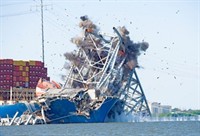
The demolition of the remaining Key Bridge structure is underway and is expected to take roughly nine more months. Now projected to cost between $4.3 and $5.2 billion, the replacement is not expected to open until approximately 2030 (the state parted ways with its original contractor over cost disputes in late April) So, though the Port of Baltimore has recovered its shipping operations, the legal disputes are far from over.Francis Scott Key might recognize something in all of this. His day job was as a practicing attorney in Washington, D.C after all, arguing cases and defining statutes. His famous poem came from a night of watching catastrophe unfold and wondering, at dawn, what still would be standing. The original bridge that bore his name may be gone, but the legal questions it has left behind will be with us for years.
We at the Herd Law Firm are proud to fight for seamen, maritime workers, and passengers in all types of personal injury and death claims. As maritime personal injury attorneys — and sailors ourselves — located in northwest Houston, we never waver in our commitment to help maritime workers, passengers, and their families when they are injured or mistreated.
5/25/2026
Maryland Office of the Attorney General — “Attorney General Brown Announces Final Settlement with Owners and Operators of the M/V Dali” (May 12, 2026): https://oag.maryland.gov
WYPR Baltimore — “Maryland reaches $2.25 billion settlement over Key Bridge collapse” (May 12, 2026): https://www.wypr.org
The Baltimore Banner — “DOJ charges Synergy Marine Group, employee in Key Bridge collapse” (May 12, 2026): https://www.thebanner.com
The Baltimore Banner — “Ship owner, operator seek delay in Key Bridge civil trial after indictment” (May 18, 2026): https://www.thebanner.com
CNN — “Justice Department announces criminal charges in Baltimore’s deadly Key Bridge collapse” (May 12, 2026): https://www.cnn.com
The Hill — “Feds file criminal charges in Baltimore Key Bridge collapse” (May 12, 2026): https://thehill.com
gCaptain — “Record $2.25 Billion Settlement Reached in Baltimore Key Bridge Collapse Case” (May 13, 2026): https://gcaptain.com
Maryland Matters — “State settles Key Bridge suit for $2.25 billion; M/V Dali owners face criminal charges” (May 12, 2026): https://marylandmatters.org
WYPR — “Justice Department’s prosecution in Maryland Key Bridge case brings legal questions” (May 13, 2026): https://www.wypr.org
Environment+Energy Leader — “Synergy Marine Indicted on 18 Counts in Key Bridge Allision” (May 2026): https://www.environmentenergyleader.com
Wikipedia — Francis Scott Key Bridge collapse (last updated May 2026): https://en.wikipedia.org/wiki/Francis_Scott_Key_Bridge_collapse
Wikipedia — Francis Scott Key Bridge replacement (last updated May 2026): https://en.wikipedia.org/wiki/Francis_Scott_Key_Bridge_replacement
United States Army — USACE responds to Francis Scott Key Bridge collapse. (2025, September 23): https://www.army.mil/article/284167/usace_responds_to_francis_scott_key_bridge_collapse
National Transportation Safety Board —Contact of containership Dali with Francis Scott Key Bridge and subsequent bridge collapse (Report No. DCA24MM031) (2025, December 10): https://www.ntsb.gov/investigations/Pages/DCA24MM031.aspx
Contact:
Charles Herd, Principal
law@HerdLawFirm.com, (713) 955-3699